Musings & Meanderings: Robin Oliveria turns her daughter’s room into an office, reads her work out loud while pacing the foyer of her home, and says all writers need life experience and determination, plus her new historical fiction A WILD & HEAVENLY PLACE–oh, and my tips on starting a new writing project
14–20 minutes
read
By Leslie Lindsay
A curated newsletter on the literary life, featuring ‘4 questions,’ reading & listening recommendations, where to submit, more
Leslie Lindsay|Always with a Book
~MUSINGS & MEANDERINGS~
Where to Start?
Writing Through Trauma
I’m approaching a new project. That sounds exciting, but daunting, too. Where to start? How to start? What genre? Does anyone care? Do I?! And then there’s the trauma involved in writing. Wait?! What? How is writing traumatic? It’s not very physical. It’s not that hard, you just sit and think and type (or write by hand), so traumatic?!
Writing is so, so challenging, on many levels (emotional, physical, mental). Let’s call it not ‘work,’ but labor. If you’re about to start out with this time-consuming, often draining labor, then I get it, I’m here for you. A few things to consider:
Reflect on your intentions.
This might mean journaling or staring into space or talking or walking. You want to approach the project with clarity and purpose.
Identify your writing blocks.
I don’t know if I believe in writing blocks in the way you might. There’s always something to write. But you will want to analyze what holds you back. Is it time? Make it. Internal angst? Work through it. Nothing to say? Write about. Truly, if you identify what is holding you back, you’ll be more empowered to push forward.
Make a self-care plan.
When I was writing about my mother, who devolved into psychosis when I was a kid (traumatic), and then was really mean to me (traumatic) and I had to move out of her home and live with dad (traumatic), and then we were estranged…and then she died by suicide, and then she haunted me (trauma, trauma, trauma), I made a plan. I would do hands-on art related to the project (with music), then go to the gym to work it all out, back to the page. I surrounded myself with supportive friends. For you, it might be nature, sunshine, journaling, dance, reading, running, baths, writing groups, or something along those lines.
Keep going!
Question:
Are you writing something traumatic? What helps you maintain balance? Is there something I may have forgotten?
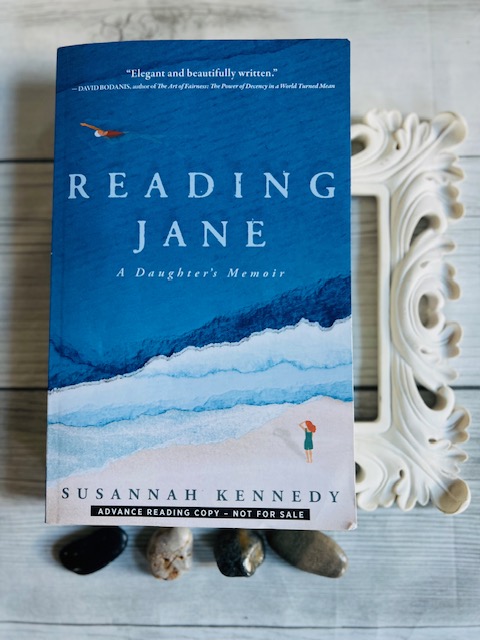
This issue of Musings & Meanderings is jam-packed with some really great stuff to get your [writing and reading] off on the right foot. Coaching, book recommendations, journals to submit to, reading recommendations, author interviews, recently published prose, and a quick 4 questions insights interview with Robin Oliveria on her forthcoming historical fiction, A WILD AND HEAVENLY PLACE(Putnam, February 13 2024). I interviewed the lovely Susannah Kennedy in Hippocampus Magazine, about her memoir, READING JANE: A Daughter’s Memoir about sifting through her mother’s letters following her death to suicide (see ‘self-care’ above), plus poetry in Ballast, Neologism Poetry Journal, Empyrean, photography in Western Michigan Review, and a photo-essay featuring miniatures in On the Seawall.
Musings & Meanderings is a labor of love. Lately, it’s been more labor than love. I’m going to try just one per month in order to focus on my own work. Find me on IG and Twitter, where you’ll find recently-published interviews, essays, photography, and poetry.
Full Interview in Hippocampus MagazineThis month’s featureDecember 2023
There’s more to this newsletter. Keep Scrolling.
By the way, I do not get any ‘kick-backs’ or other kind of payment (in-kind, or otherwise) for mentioning these classes/workshops/books/individuals. Sharing because if helps me, maybe it’ll speak to you, too.
I was recently in conversation with another writer, a poet, who recommended Sharon Olds’s piece about her young parents, a sort of warning/ode to their blooming relationship. I read the poem at dinner and then the next day, this piece popped into my in-box, about how Sharon still writes by hand in a notebook. I love these synchronicities.
From the New York Times bestselling author of My Name is Mary Sutter comes a sweeping story of star-crossed lovers and the birth of Seattle.
How far would you go? How much would you risk? Hailey MacIntyre seems conjured from the depths of Samuel Fiddes’s loneliness. Caring for his young sister in the tenements of Glasgow, Scotland, Samuel has known only hunger, while Hailey has never known want. Yet, when Samuel saves Hailey’s brother from a runaway carriage, their connection is undeniable.
Leslie Lindsay:
Without responding in complete sentences, what would you say A WILD AND HEAVENLY PLACE is about?
Robin Oliveira:
Love. Hope. Persistence. Loyalty. Honor.
Leslie Lindsay:
Where did you write A WILD AND HEAVENLY PLACE? Do you have any special writing routines or rituals? Do they change with each project, or remain constant over time?
Robin Oliveira:
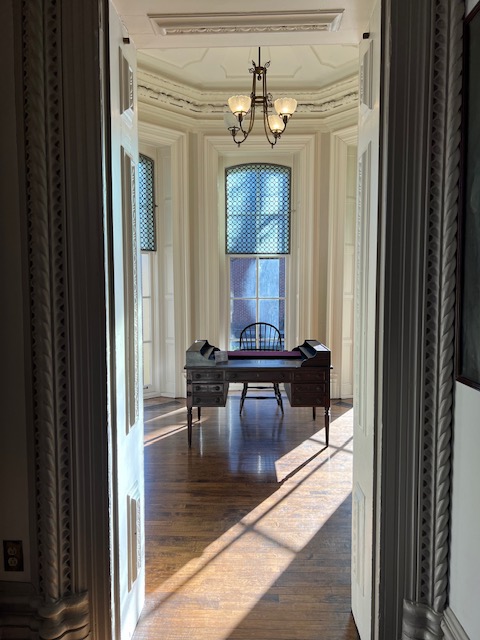
I repurposed my daughter’s bedroom into an office after she left home. I write weekdays until three pm, which is about when my brain turns off. At different points in the publication process, I shift to different rooms of the house. For instance, for final writing edits, I read the printed pages of the manuscript out loud pacing in a circle in the entry way of my home (the largest amount of empty square footage). Somehow, movement helps me to process what I’ve written, and to hear the story in a way I hadn’t before. I discover places where the diction or syntax is falling short. When the process moves to copyediting, I set up at the kitchen counter to do the tedious work of searching for errors. This process of changing up the scenery seems to signal my brain to operate differently. (Writing is different from editing is different from copyediting.)
Leslie Lindsay:
If you weren’t writing, you would be…
Robin Oliveira:
… still be an ICU/CCU nurse. I loved the work.
Leslie Lindsay:
What advice would you give to your younger writing self?
Robin Oliveira:
I can only say what I did, and hope that it is helpful for others. I was very determined to learn how to write novels. What I didn’t know was how hard it was going to be. So, younger self: It’s harder than you think it will be. BUT—this is important—what you don’t know is that learning to write is difficult for everyone. It’s not a reason to be hard on yourself, and it’s not a reason to quit, either. (I never quit. I was determined, even when other people gave me the patronizing head tilt: Oh, you want to write novels? How nice. People will say all kinds of things to you. Ignore them.)
This is my advice to everyone: Two things will get you through the early years—and the later years, too. Be persistent—head down, putting words to page while reading as many books as you can. In that persistence, learn the craft of writing. In whatever way that learning is available to you, pursue the help. My first novel was never published, even though I had obtained an agent for it. When that happened, I knew that there were things about writing novels that despite a lifetime of reading, I still didn’t understand. I enrolled in evening writing classes at my local community college, then extension courses at the local university, and finally an MFA program. In doing that I not only learned the elements of writing, but I also gained community, inspiration, and support. This kind of formal approach was extremely helpful to me. It may not work for you, but it did for me.
What I say to very young writers is this: Live. Get a hard job. Fall in love. Get your heart broken. Explore the world. Engage with everything. You cannot write if you haven’t experienced. There are notable exceptions, of course, people who can write in isolation from a deep well of imagination and perception. I salute them. But it’s easier to write about life if you’ve lived it.
“A story of love, despair, jealousy, revenge, and hope…Beautiful.”
— –Elizabeth George, New York Times bestselling author
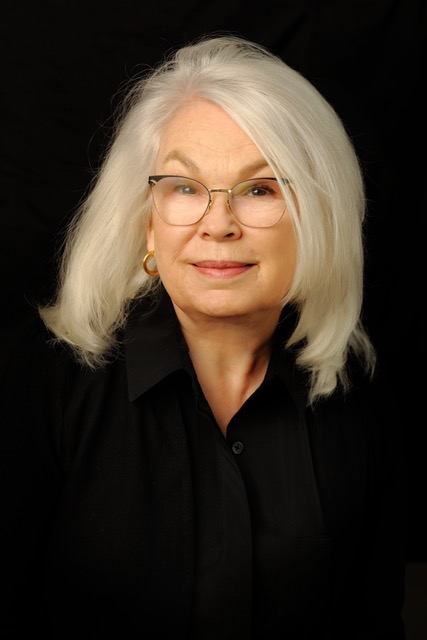
Image designed & photographed byL.LindsayPhoto courtesy of the author
For more information, to purchase a copy of A WILD AND HEAVENLY PLACE or to connect with the author via social media, please visit her website.
ABOUT THE AUTHOR:
Robin Oliveira is the New York Times Bestselling author of four novels: the forthcoming (Feb 2024) A Wild and Heavenly Place, Winter Sisters, I Always Loved You, and My Name is Mary Sutter. She is a former Registered Nurse, specializing in Critical Care and Bone Marrow Transplant, holds a B.A. in Russian, and received an M.F.A. in Writing from Vermont College of Fine Arts. Recognition includes the 2007 James Jones First Novel Fellowship, May 2010 Indie Next List, February 2024 Indie Next List, the 2011 Michael Shaara Prize for Civil War fiction, an Historical Novel Society Editor’s Choice, a Good Housekeeping Top 10 Read, USA Today Bestseller, ABA Indiebound Bestseller, Oprah Magazine Editor’s Pick, several All City reads, 2015 Iowa All State Read, People Magazines’ Best New Books, USA Today Top Five Reads, a Kirkus Starred Review for Winter Sisters, and finalist for the 2019 Washington State Book Award. Her books have been translated into several languages. She currently lives outside of Seattle, Washington with her husband, Andrew Oliveira.
What books or essays you’ve read and enjoyed or felt energized by lately? Is there a book you’ve been consistently recommending? If nothing comes to mind, can you make a plan to pop by your local bookstore for a second? I promise, you will find something. You can respond in the comments or shoot me an email or connect on IG.
Do you read books because they will help you write or flush out an obsession? Do you read ‘hot’ books to discuss and see what the hype is all about? An escape? Something else? I recently–finally–picked up a copy of LESSONS IN CHEMISTRY. I was resistant at first. But now…well…jury’s still out. Thoughts?
I just received the SUMMER (!!) catalog from Penguin Random House and omg–swooning. What do you look for in a summer book? Light and easy? Must it contain a beach? Maybe your workload is lighter and you crave something a little more heady? What are your favorite summer reads? Bonus points for backlist books.
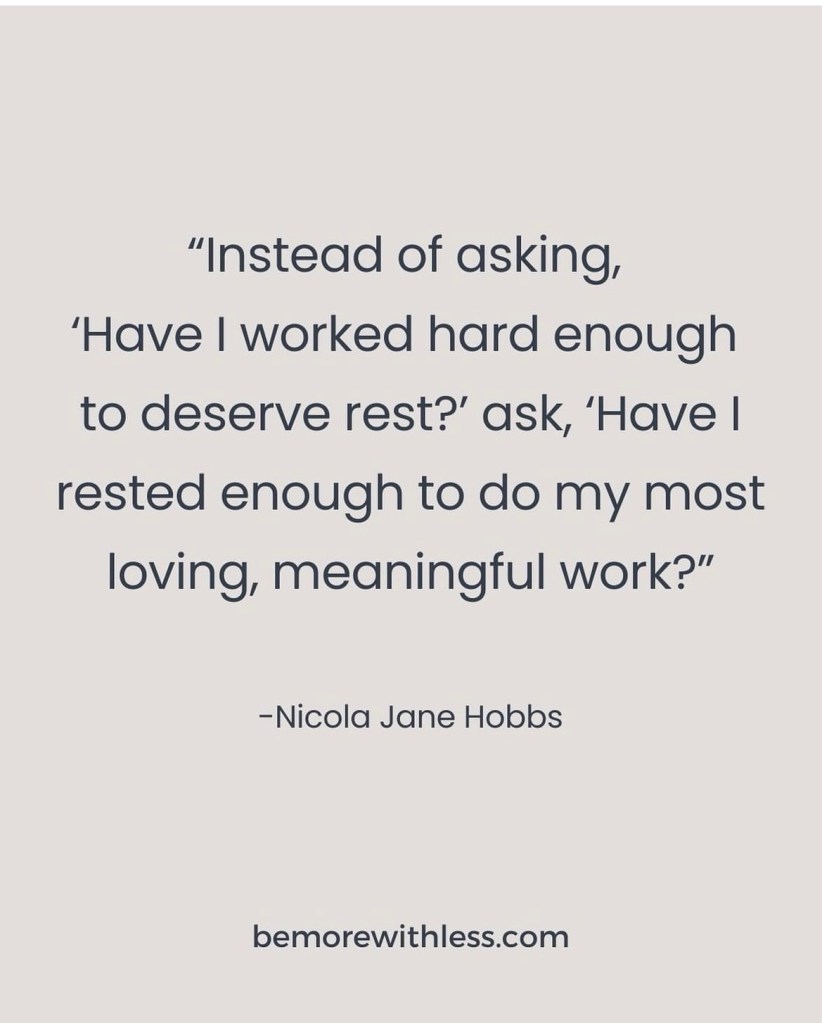
Reading and rest. Is there a correlation? I’m not sure. Most of the time, when I’m reading, I’m ‘reading like a writer.’ It’s hard to switch off this part of my brain and just enjoy the story, the writing, but…well, on the other hand, I am at least sitting. Does that count?!
Recently Published Interviews, Prose, Etc.:
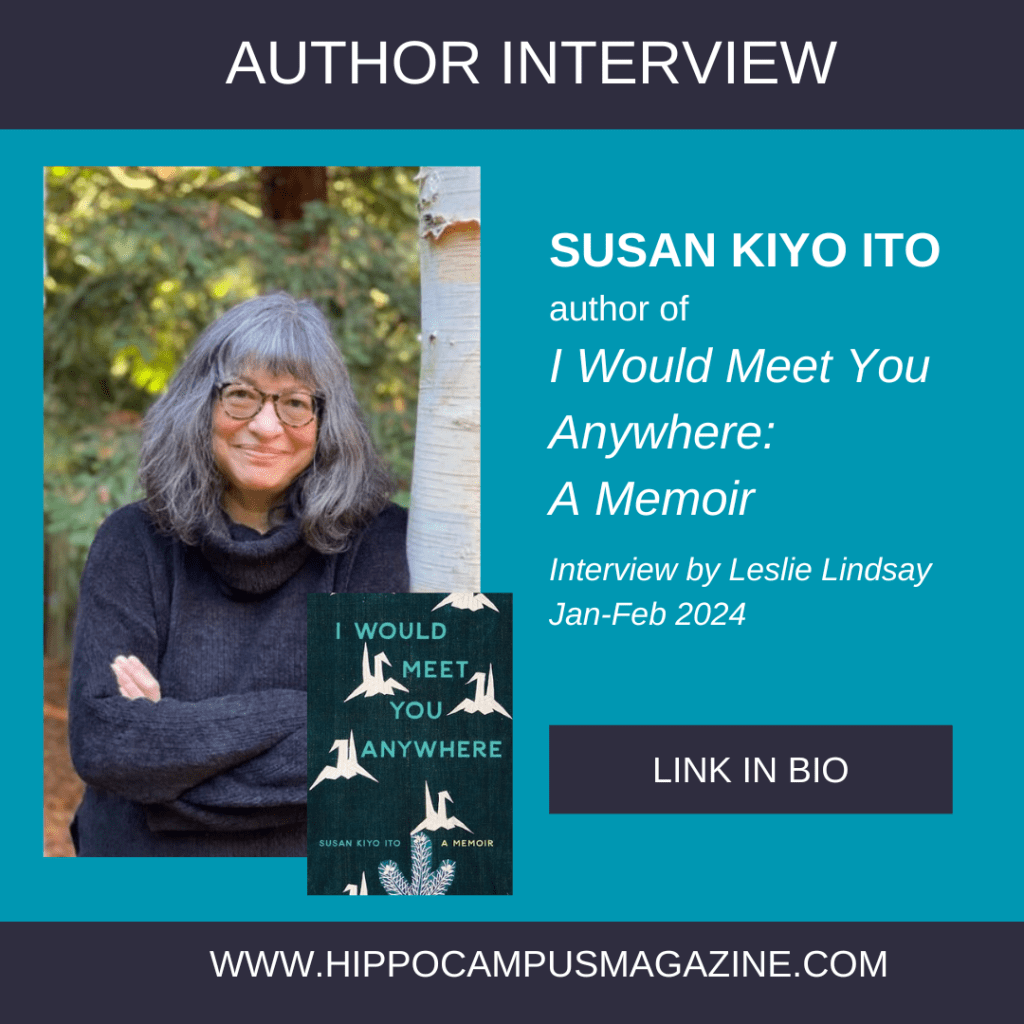
It took Susan Kiyo Ito 30 years to finish her debut memoir, I WOULD MEET YOU ANYWHERE (Mad Creek Books/Ohio State Press, 2023) and it’s a masterpiece. Nominated for a NBCC award. Check out my interview with her in the Jan-Feb 2024 issue of Hippocampus Magazine.
Such an important and affirming interview with the lovely award-winning journalist Meg Kissinger about her recently-released memoir, WHILE YOU WERE OUT (September 2023, Celadon Books), about a large family with mentally unstable parents, a family plagued by suicide, plus a plea to improve housing for mentally ill. In the November issue of Hippocampus Magazine.
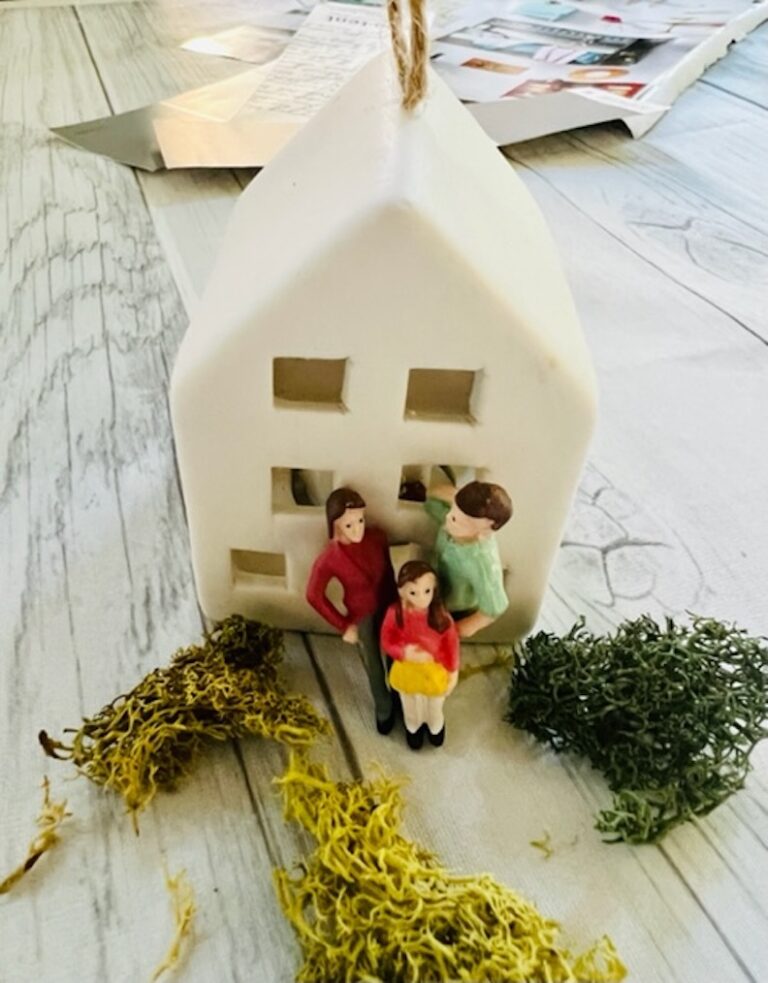
This piece, MODEL HOME: A Study Under Compression, in On the Seawall, is something I am so proud of. It was conceived in a craft store when I wandered down the model train aisle. At home, I already had the moss and tiny house and vials. I wanted to depict something with words and photography that would spotlight my family falling into disarray…my mother’s mental illness, the ‘perfect’ home, the family divided. This was my answer. It’s my first text + image publication. Here’s a sampling:
I am bowled over by the reception my poem, CREVASSE, received by Luke Johnson in the Spring 2023 issue of Ballast. Check out our dialogue about one another’s work HERE. Also, that landing page! Swooning.
You can find some of my other poetry atEmpyrean Literary Journal. This piece was conceived in a workshop at StoryStudio Chicago in which the prompt was to combine two totally different things with one’s childhood street. I chose my grandfather’s profession as stained-glass artist and the year 1989. The resulting piece is COLLAPSE.
This interview with poet Pattiann Rogers in LitHub was such a dream. Pattiann is 82-years-old and still writing and publishing poetry. This piece is about nature, curiosity, and the flickering that happens in all creatures.
Super-excited about this illustrated review inDIAGRAM, which has sorta been like a dream place of mine to get work published. It’s a beautiful melding of all things that bring me joy: fonts, words, ideas, art, books, and the human body. I mean…the only obsessions missing for me is architecture, travel, nature, and basset hounds. Check it out and the book, YOUR HEARTS, YOUR SCARS: Essays by the late Adina Talve-Goodman (Bellevue Literary Press, Jan 24 2023), which happens to be a Powell’s pick for January.
My illustrated review of YOUR HEARTS YOUR SCARS (Bellevue Literary Press, Jan 24 2023) as it appears in DIAGRAM 22.6
Kathryn Gahl in conversation with me about her poetic memoir,THE YELLOW TOOTHBRUSH(Two Shrews Press, September 2022), about her incarcerated daughter, perinatal mood disorder, more in MER, November 28, 2022.
Sarah Fawn Montgomery’sHALFWAY FROM HOME(Split/Lip Press, Nov 8) in Hippocampus Magazine, about her working-class unconventional childhood in California, moving across the country to pursue writing, home, displacement, and so much more November 13, 2022.
Prose in SEPIA Journal Oct/Nov 2022 issue. Interiors is about an Appalachian family, black bottom pie, trains, and ear aches. It was inspired by my own family lore, and also: this journal is STUNNING!
An essay about an experience at a workshop/retreat, featuring design/architecture, and how we are all works-in-progress, in The Smart Set.
Census maps because they are different than actual maps. They told the census-takers where to go (often on foot), when conducting the census. Some of the residences from the past are no longer. Small towns have gone extinct or merged with others, or renamed. I find this actual act of erasure a totally compelling metaphor.
Vintage wallpaper. I became obsessed with William Morris wallpaper while staying Ragdale for a writing residency. From what I can tell, the original William Morris wallpaper is long gone from the walls, but some reproductions still adorn the walls. I became so obsessed, I ordered a William Morris-inspired watch.
Old houses. This week alone, I’ve been in three restored historic homes. They are my lifeblood.
Much of writing is made up of obsessions. We might use our obsession as catalyst, something that gets us writing and, if lucky, keeps us writing.
Sometimes we write about our obsession directly, hoping (perhaps futilely) to be purged free of it, once and for all.
Susan Sontag, while talking about writing and the writer’s life, said it simply:
“You have to be obsessed. It’s not something you’d want to be—it’s rather something you couldn’t help but be.”
What subjects do you keep returning to—from harmless infatuations to downright obsessions? Is it a piece of art of music? Why are you (okay, me) so obsessed with houses and homes? Old photographs? Paper and erasers and pencils? Basset hounds? Postcards? Old letters? Miniatures? I mean, really….the list could go on and on.
More thoughts on obesssion and writing mentors–by the way, do you have one? It may not be a mentor, per se, but an accountability partner, someone to check in with you on projects, keep the momentum going. Here’s what Gayle Brandeis says:
“A good writing mentor will ultimately help each student trust their own voice and will give the student tools and confidence to carry their unique vision forward.”
Until next time, happy writing& reading.
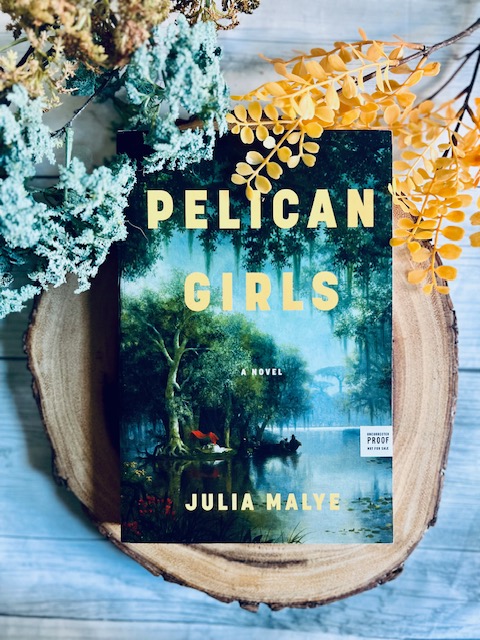
Sneak Peek: In March, I’ll feature a 4Qs mini-interview with Julia Malye, author of PELICAN GIRLS.
Are we connected on IG? That’s where I’ll be sharing snippets and highlights until the next issue of Musings & Meanderings.
You are reading Musings & Meanderings, a consistently inconsistent weekly newsletter about the literary life from Leslie Lindsay, and home of an archive of bestselling and debutauthor interviews. I’m also on twitterandinstagram. I try to answer comments as best I can. Feel free to find my book suggestions onbookshop.org, and also check out the authors I’ve hosted in in-depth interviews HERE.
Some of you have been reading my reviews, interviews, and meanderings for more than a decade now. That’s huge and I am so humbled. Thanks for being here.
I support writing organizations, authors, publishers, and more. Occasionally, you’ll get a peak behind-the-scenes, too.
Get occasional bookish news delivered to your inbox.
One last thing: I love Between the Covers podcast with David Naimon. Not listening yet? If you’re a serious reader and writer, I don’t think you’ll regret it.







 Leslie A. Lindsay
Got something to say? Tell us!!